Top website maintenance priorities for early-stage startups in Cape Town
by Julius, Director & Strategic Development Partner
Most Cape Town founders pour energy into the build, the pitch, and the go-live date, then shift their attention to sales, product, and growth the moment the site is live. Website maintenance rarely makes the post-launch plan. The site just sits there, quietly accumulating risk. At Faseelus, a Cape Town technical partner, this is one of the most predictable patterns we see: a well-built MVP at launch that starts fraying because nobody has a plan for ongoing site upkeep. This article gives you that plan.
It covers what tasks to run and when, what ongoing website maintenance actually costs in South Africa in 2026, how different support models compare, and how to decide what is right for your stage. No fluff. Just what you need to keep a live platform healthy.
Why your MVP needs regular upkeep, not just a successful launch
Software dependencies age quickly. A codebase that was current at launch becomes a liability within months if nothing is updated. Plugins get patched, libraries release security fixes, and third-party APIs change their behaviour. If you are not keeping pace, the gap between what your site runs and what it should run grows steadily wider.
Security vulnerabilities compound over time. Unpatched CMS versions and outdated plugins are the most common entry points for attacks on small South African business sites. Sample audits of South African business sites indicate that roughly 60% run outdated plugins or themes with known security vulnerabilities, and approximately 31% have plugins with known critical vulnerabilities, figures that, while drawn from audited samples rather than a representative national survey, point to a widespread and serious pattern. Many founders assume that being a small startup offers some protection. It does not. Attackers use automated tools that scan thousands of sites simultaneously for vulnerable plugins and known exploits, regardless of the site owner's revenue or profile.
Performance also degrades silently. Database bloat, unoptimised assets, and accumulated content errors slow your site without anyone noticing until users bounce. By the time the problem is visible, it has already cost you. The real cost of doing nothing is not zero: it is the sum of reactive emergency fixes, reputation damage, and lost users. Neglect is not a neutral choice. It is a slow accumulation of avoidable risk.
The website maintenance checklist every Cape Town startup should use
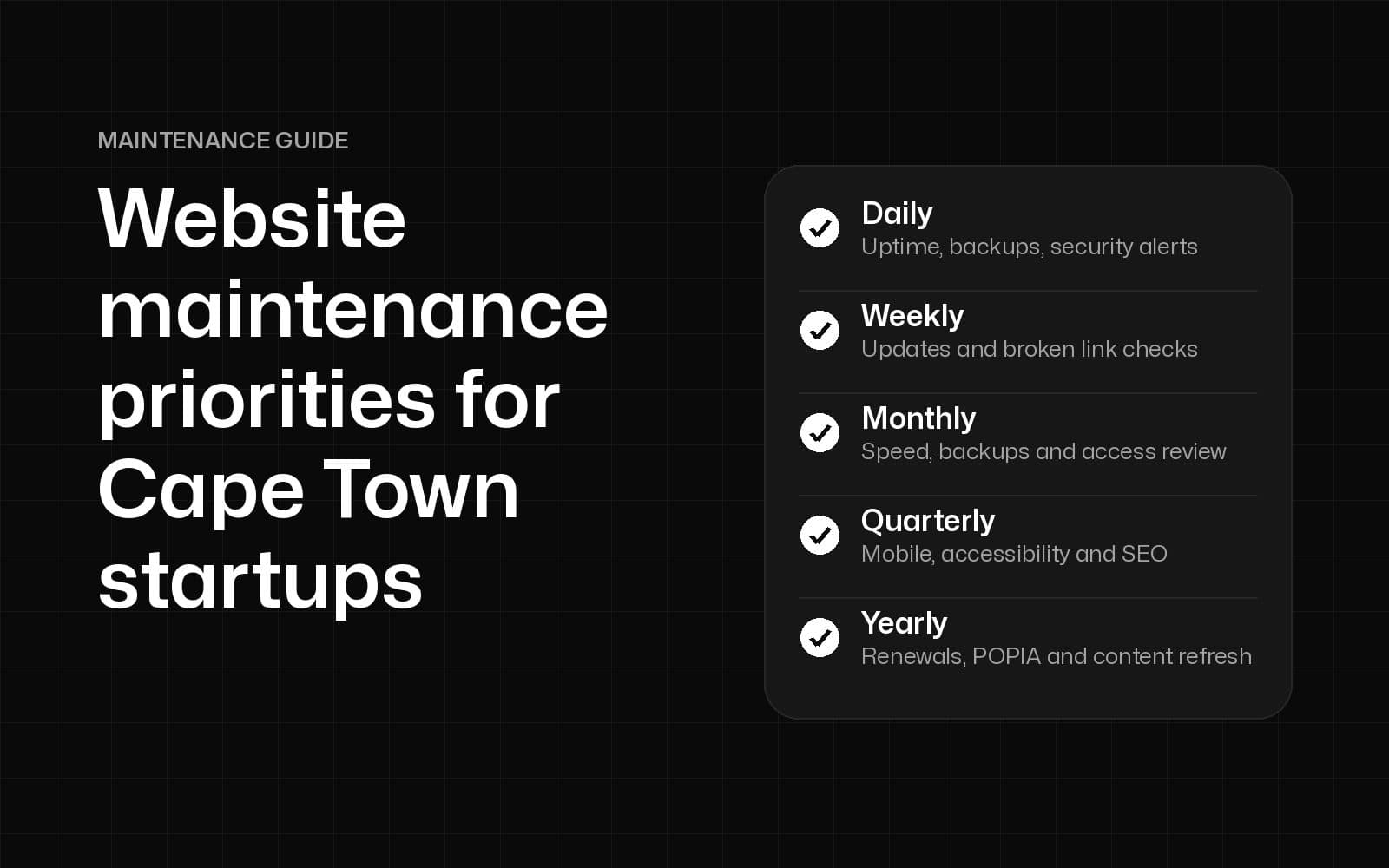
Structure your site care by cadence, not by urgency. Urgency is what you get when cadence breaks down. The framework below covers daily non-negotiables through to annual housekeeping.
Daily and weekly tasks
Daily tasks are your vital signs. Run uptime monitoring, verify automated backups, and review security alerts. If you are not checking these daily, you are flying blind. For any site with transactional functionality or paying users, also test critical forms and checkout flows at least three times a week, daily if your platform processes payments.
Weekly tasks keep the foundations solid. Apply CMS core updates, plugin and dependency updates, and theme updates as soon as they are available. Do not queue them for "when there is time." Also run broken link checks and verify that key user touchpoints are working. Unpatched plugins are one of the most exploited vulnerabilities on WordPress sites in South Africa; a weekly WordPress maintenance cadence is not excessive, it is necessary.
Monthly and quarterly health checks
Monthly, review your performance reports and run a load speed test. Audit content freshness, check backup integrity, and review user access permissions. Remove any accounts that are no longer active. Dormant accounts with admin access are a security risk that is easy to overlook and easy to close.
Quarterly reviews are where you catch design debt before it becomes conversion loss. Test mobile responsiveness, run accessibility checks, review your SEO health, and look honestly at the user experience. This matters especially for startups because your product evolves fast. The site often lags behind where the company has moved to, and a quarterly review forces that alignment.
Annual housekeeping and renewals
Domain, hosting, and SSL renewals are the ones that break sites when founders forget them. As a practical recommendation, set calendar reminders at least eight to twelve weeks out, not one week out. That lead time gives you room to resolve any transfer or billing complications, registrar delays and payment issues are more common than founders expect, without it becoming a crisis.
Your annual review should also cover legal compliance: POPIA obligations, privacy policy currency, and cookie consent. Do a full content refresh to make sure the site still reflects its current state. This is also the right moment to review whether your current website management plan still fits your scale. A model that worked for a pre-launch brochure site is not necessarily right for a platform with three thousand active users.
Three maintenance models and what they actually mean in practice
In our experience, most founders inherit a maintenance model by default rather than choosing one deliberately. That default is usually ad-hoc, and it almost always costs more than a structured approach would have.
Ad-hoc fixes: low commitment, high risk
Ad-hoc means you call someone when something breaks. There is no standing relationship, no proactive monitoring, no scheduled updates. You pay per incident. The appeal is obvious: no monthly cost when nothing goes wrong. The problem is that things go wrong in ways you cannot predict, and you are always reacting instead of preventing. For sites at the very earliest stage, pre-revenue with a static brochure presence, ad-hoc may be acceptable for a short window. It is not a sustainable model as soon as you have paying users or transactional functionality.
Monthly retainer plans: predictable and proactive
A retainer means a fixed monthly fee for a defined scope of ongoing work: updates, backups, monitoring, and a set number of support hours. The provider knows your site. The relationship is ongoing. Issues get caught before they become emergencies, and you can budget properly without surprise invoices. This model suits most early-stage startups once they have launched their MVP and have active users. In South Africa, website support services on a retainer basis for small-to-medium sites typically run R500 to R3,000 per month, with more active or complex sites reaching R5,000 or more depending on scope.
Website maintenance retainer: what to expect from an SLA-backed plan
SLA-backed support defines response times by severity, by priority level (critical, high, and normal), alongside uptime commitments and escalation processes. In South African web maintenance contracts, the common pattern is: critical issues acknowledged within 15 minutes to one hour, high-priority within one to four hours, and normal within four to twenty-four business hours. This model is for scale-ups with significant traffic, e-commerce functionality, or enterprise clients. Monthly cost for SLA-backed plans with a capable South African development studio typically starts at R3,500 and can reach R10,000 or more for complex platforms. The structured accountability is what separates a professional technical partnership from a casual arrangement.
What website maintenance costs in South Africa in 2026
Pricing in South Africa breaks down cleanly by site type and scope. The breakdown by site type looks like this:
- Personal or blog sites: R100 to R600 per month for basic updates, backups, and monitoring.
- Small business sites: R500 to R2,500 per month covering security monitoring, updates, performance checks, and minor content edits.
- Content-heavy or growing platforms: R2,000 to R5,000 per month as scope expands to include dependency management, deeper audits, and more support hours.
- E-commerce and transactional sites: R2,500 to R8,000 or more per month where uptime, security, and payment functionality require closer attention.
- Hourly rates for freelancers or ad-hoc providers: R300 to R900 per hour is the typical South African market range in 2026.
At the lower end, you are paying for execution: updates run, backups made, alerts reviewed. There is minimal strategy or proactive communication. At the mid-range, a good provider brings a structured site maintenance calendar, monthly reporting, and a consistent point of contact who knows your platform. At the higher end with SLA-backed support, you get defined accountability, strategic input, and a partner who treats your site as a live product rather than a static asset.
For context on why these costs are worth taking seriously: downtime for a 30-person South African SME is estimated at R5,000 to R20,000 per hour. A month of retainer fees is often less than a single unplanned outage. That comparison is worth keeping in mind when evaluating whether a website management plan is an expense or an investment.
How Faseelus moved a Cape Town client from ad-hoc chaos to a predictable retainer
The following is an anonymised account of a client engagement. One of our Cape Town clients launched a custom platform with us and then managed post-launch maintenance ad-hoc: calling in when something broke or felt slow. Over eight months, a pattern emerged. A security vulnerability patched in an emergency. A plugin conflict that broke a key feature for three days. A missed hosting renewal that caused a brief outage. Each incident was resolved, but each one cost more than it should have in both time and stress.
The client was spending more on reactive fixes than a structured retainer would have cost, without any of the peace of mind a retainer brings. We proposed a website management plan covering weekly updates, daily uptime monitoring, monthly performance reviews, and a defined support SLA. The monthly cost was predictable and lower than the average monthly spend on ad-hoc incidents had been.
Within three months, incident frequency dropped noticeably. The team had visibility into the platform's health. Updates were no longer an afterthought. The outcome was not just fewer problems, it was a client who could focus on growing the business instead of firefighting the infrastructure. That is what post-launch product ownership looks like in practice.
When to handle maintenance yourself and when to bring in a technical partner
If you have a technical co-founder, a developer on staff, or a very simple brochure site, in-house site management is viable for a period. The condition is that someone actually owns it and follows a consistent schedule. The tools exist to support a capable in-house maintainer: UpdraftPlus or Duplicator for backups, Wordfence for security, ManageWP for update management, LiteSpeed Cache for performance. Most have free tiers sufficient for early-stage needs.
The honest risk is that in-house maintenance tends to slip when the team is busy. And the team is always busy at a startup. The tasks feel low-stakes until they are not, and by then you are dealing with a preventable incident under pressure.
You need an external technical partner when any of the following are true: you are spending unplanned hours on site issues instead of core business work; you have paying users or transactional functionality where downtime has direct business consequences; your platform is growing in complexity and your dependencies are multiplying; or you want to iterate on the product post-launch but do not have the bandwidth to also maintain what already exists.
At that point, a partner like Faseelus makes practical sense, a studio that already knows your architecture and treats the platform as a living product rather than a finished deliverable. Reach out to the Faseelus team to talk through what a structured website maintenance plan looks like for your specific platform.
Launching is not the finish line
A live website is a live system, and live systems need care. The checklist, the cadences, and the right maintenance model are not complicated. They are just easy to defer until something breaks. For most Cape Town startups, the shift from ad-hoc to a structured retainer is the single most impactful change they can make to the health of their platform.
The work is not glamorous. It does not have a launch date or a champagne moment. But it is what separates a platform that compounds in value from one that slowly becomes a liability. If your team is ready to stop firefighting and start website maintenance with intention, get in touch with us at Faseelus. That conversation is worth having before the next incident, not after it.